Start with a tape measure on the ceiling. That is the first thing any contractor should do before quoting a basement apartment, and it is the single measurement that determines whether a project is straightforward or whether the entire budget needs to shift.
The Ontario Building Code requires 1.95 metres (6 feet 5 inches) of clear ceiling height throughout a legal basement apartment. Most homes built before 1990 in Barrie do not have that. If yours is short, the project needs underpinning before the apartment build can start, and that changes the scope, timeline, and cost significantly.
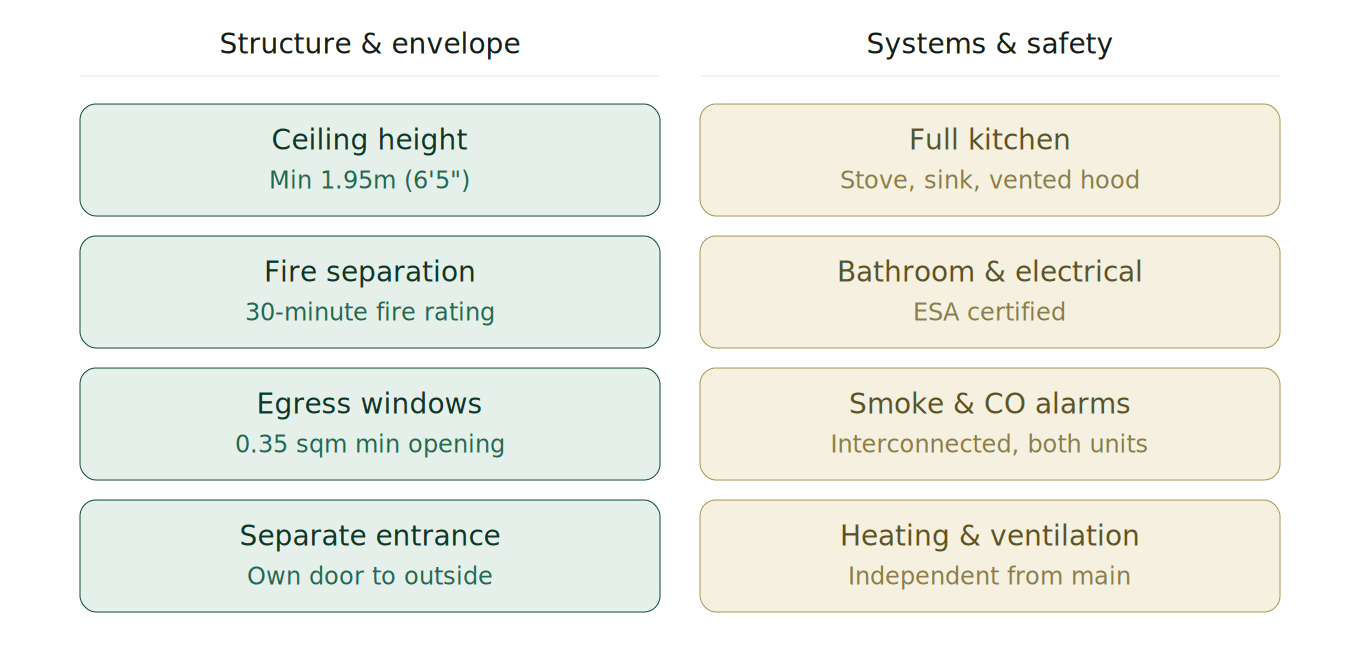
Ceiling height is one requirement out of eight. A legal basement apartment in Ontario has to meet every one of them, including the Ontario Building Code, the Ontario Fire Code, and your local zoning bylaws. Missing any single requirement means the unit is not legal, your insurance likely will not cover it, and the city can order you to stop renting.
This guide covers every requirement, with specific details for Barrie and Simcoe County where the local rules go beyond the provincial code.
Ceiling Height
This is the requirement that stops the most projects before they start.
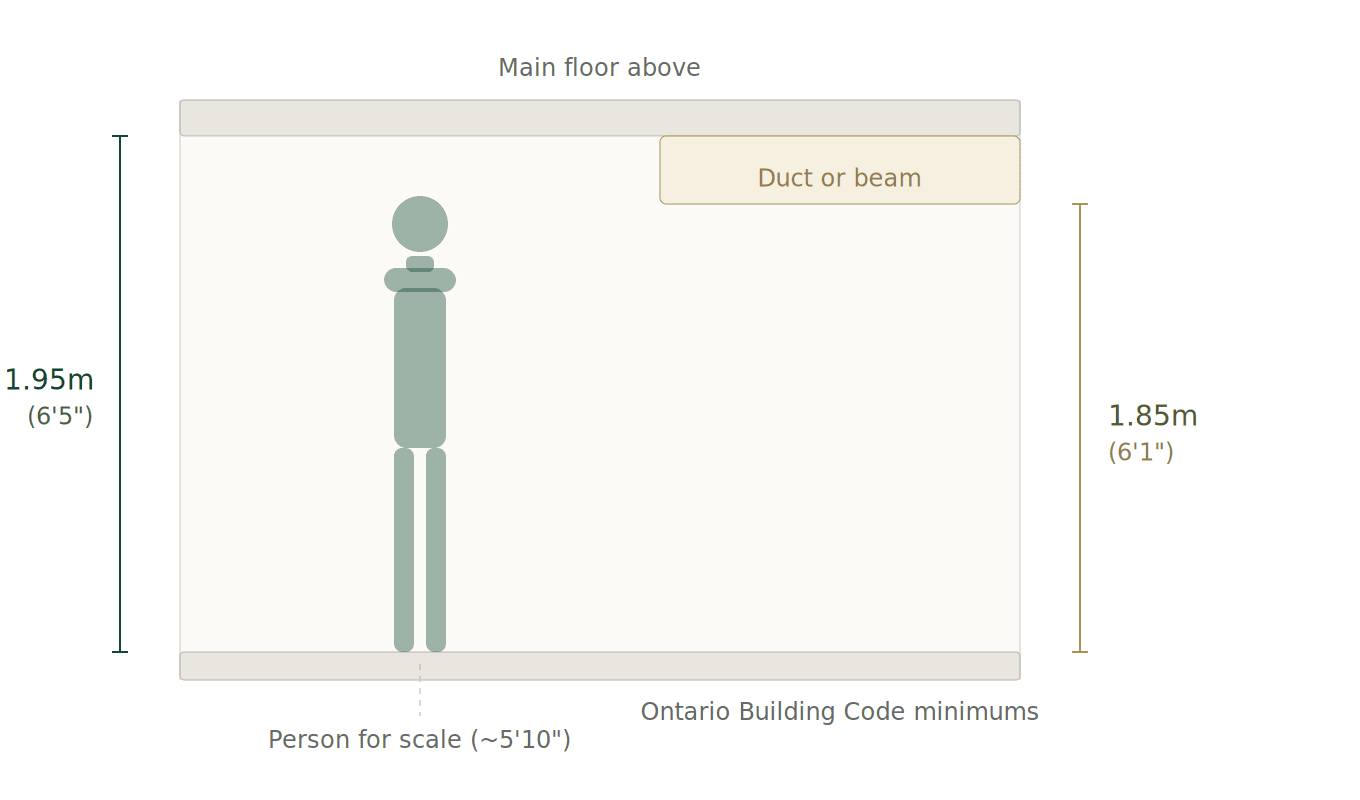
The Ontario Building Code requires a minimum ceiling height of 1.95 metres (6 feet 5 inches) throughout the entire basement apartment. That measurement applies to every room the tenant uses: the kitchen, living area, bedrooms, hallways, and the path to the exit.
Under beams, ducts, and bulkheads, the minimum drops to 1.85 metres (6 feet 1 inch). That reduced height is only allowed at specific obstruction points. It cannot be the general ceiling height of the unit.
Most homes built before 1990 in Barrie have basement ceilings at six feet or less. If that describes your home, you have two real options.
Underpinning lowers the basement floor by excavating beneath the existing foundation and extending it deeper. It requires a structural engineer, a separate building permit, and typically costs $50,000 to $80,000 or more depending on depth and layout. The result is permanent additional ceiling height and a basement that feels like a proper floor of the house. Learn more about basement underpinning in Barrie.
Bench footing is less invasive and less expensive, but it reduces your usable floor area because the benched sections along the foundation walls take up space. For smaller basements, that trade-off can be significant.
There is no workaround for ceiling height. If you are short of 1.95 metres, you either lower the floor or you do not have a legal unit. Thinner flooring, creative trim, and shaving concrete will not close a meaningful gap.
Fire Separation
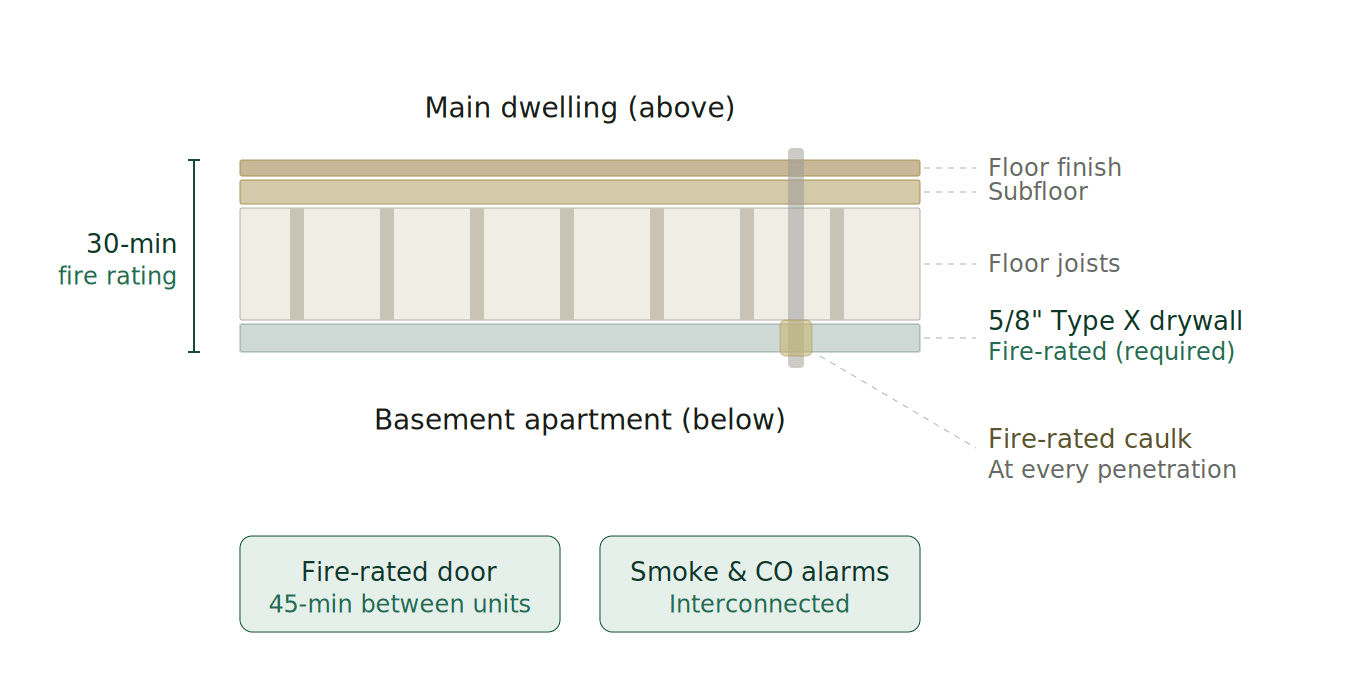
The Ontario Building Code requires a minimum 30-minute fire separation between the basement apartment and the main house above. The walls and ceiling between the two units need to resist fire for at least 30 minutes before it can spread from one unit to the other.
In practice, this means installing 5/8-inch Type X drywall on both sides of every separating wall and on the basement ceiling beneath the main floor. Standard 1/2-inch drywall does not meet the requirement. This is one of the first things a building inspector checks, and it is not negotiable.
Any door between the basement apartment and the main house needs a 45-minute fire rating. These are solid-core, fire-rated doors with self-closing hardware. A standard hollow-core interior door from a home improvement store does not qualify.
Every penetration through the fire separation needs to be sealed with fire-rated caulk or intumescent putty. That means every pipe, duct, wire, and electrical box that passes through the ceiling or separating walls between units. This is the detail that catches the most projects at inspection. We have seen basements where the framing, drywall, and flooring were done properly, but the inspector failed the project because unsealed penetrations compromised the fire barrier. Every single one has to be addressed before sign-off.
Egress Windows
Every bedroom in the basement apartment needs an egress window large enough for someone to climb through in an emergency.
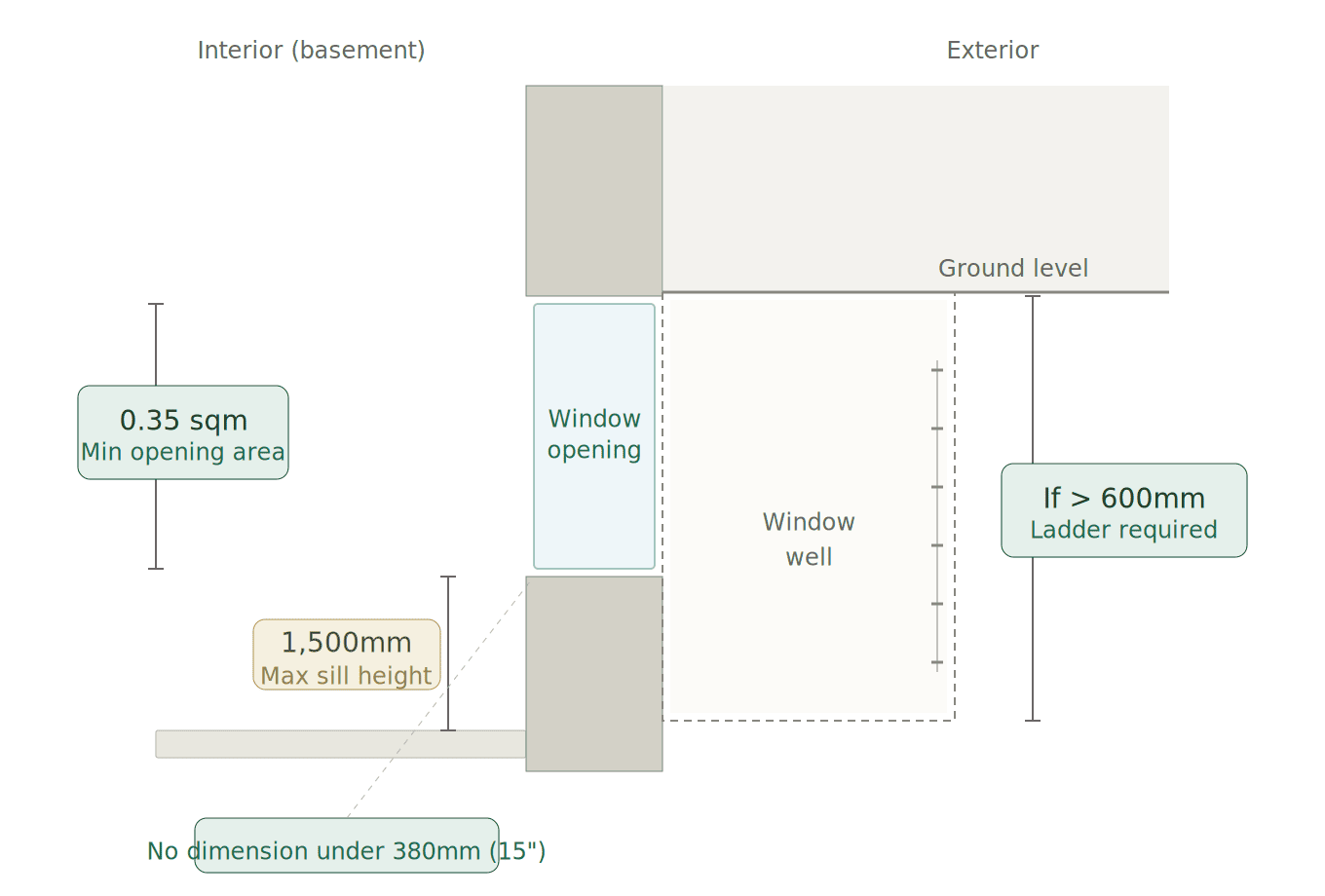
The Ontario Building Code requires egress windows to have a minimum unobstructed opening of 0.35 square metres (about 3.8 square feet), with no single dimension less than 380 millimetres (15 inches). The bottom of the window opening cannot be more than 1,500 millimetres (about 5 feet) above the finished floor.
If your basement has the small horizontal slider windows that were standard in Ontario homes through the 1980s, they almost certainly do not meet these requirements. Upgrading means cutting the foundation wall to create a larger opening, installing a new window, and building a properly drained window well on the exterior.
Cutting a larger window opening through a poured concrete foundation is noisy, dusty, and disruptive to the rest of the site. It is also one of the most important safety upgrades in the entire project. We schedule this work early so the concrete dust is cleared before interior finishing begins.
If the window well on the outside is deeper than 600 millimetres (about 2 feet), it needs a permanently attached ladder or steps so someone can climb out. The well also needs drainage to prevent it from filling with water.
Separate Entrance
A legal basement apartment in Ontario must have its own entrance that does not pass through the main dwelling. Your tenant cannot walk through your kitchen or mudroom to get to their unit.
The most common option is a side entrance with exterior stairs leading down to the basement. A walkout basement that opens directly to grade at the rear of the house also works well. A shared vestibule at the front door with separate locked doors leading to each unit can meet code, but it is less common and less practical for both parties.
The entrance and the path to it need to be well-lit, accessible year-round, and properly maintained. In Barrie, that means snow and ice clearing through winter is your responsibility as the landlord.
If your home does not currently have a separate entrance to the basement, adding one involves excavation, concrete cutting or forming, a new exterior door with proper weather sealing, and a landing that meets code. Budget $8,000 to $20,000 depending on the approach and site conditions.
Kitchen and Bathroom
A legal secondary suite needs a full kitchen with a sink, a stove or cooktop, a range hood, a refrigerator, and adequate counter and storage space. A microwave and a mini-fridge in the corner do not count.
The range hood must exhaust to the outdoors. Recirculating hoods that filter air and blow it back into the room do not meet code for a secondary suite. Venting a range hood to the exterior from a basement often requires running ductwork through or along the rim joist area, which affects your wall and ceiling layout early in the design phase.
The apartment also needs at least one three-piece bathroom: toilet, sink, and a shower or tub. Ventilation in the bathroom must exhaust to the outdoors as well.
Where your existing plumbing stack sits relative to where you want the kitchen and bathroom makes a meaningful difference to the budget. A kitchen directly adjacent to the stack might add $3,000 to $5,000 for plumbing rough-in. A kitchen on the opposite side of the basement could add $8,000 to $12,000 because of the additional below-slab trenching required to reach the drain lines. This is one of the first things we assess during a site visit because it shapes the floor plan and the budget.
Electrical
All electrical work in a legal basement apartment must be completed by a licensed electrician and inspected by the Electrical Safety Authority (ESA). When the work passes, you receive an ESA certificate that you will need for your final building inspection and for your insurance.
The suite needs its own electrical panel or sub-panel with enough capacity for kitchen appliances, lighting, heating, and general use. Circuits serving the suite should be separated from the main house. AFCI protection is required on bedroom circuits, and GFCI protection is required in the kitchen, bathroom, and laundry areas.
Many older Barrie homes were built with 100-amp electrical service. If you are adding a full apartment with a kitchen, laundry, and electric heating, a service upgrade to 200 amps may be necessary to support both units. Your electrician will assess this early in the project. It is better to know upfront because a service upgrade adds $3,000 to $6,000 to the budget.
Smoke Alarms, Carbon Monoxide Detectors, and Interconnection
Both units need interconnected smoke alarms on every level. Interconnected means that when one alarm goes off, they all go off in both the main house and the basement suite simultaneously. Carbon monoxide detectors are required near every sleeping area and on every level that has a fuel-burning appliance or is adjacent to an attached garage.
Standalone battery-operated smoke detectors do not meet this standard for a secondary suite. The whole system has to be wired together or connected through a compatible wireless interconnection system. This is one of the most commonly missed items in basement apartment renovations, and inspectors check it carefully.
Ventilation and Heating
The basement apartment needs adequate heating that can maintain a comfortable temperature independently of the main house. The simplest approach is extending the existing HVAC system with dedicated supply and return runs to the suite. Some homeowners install a separate furnace or a ductless mini-split system, which also simplifies utility separation.
Fresh air supply must be adequate for the unit’s size and occupancy. An HRV (Heat Recovery Ventilator) is not required by code in every situation, but it is a smart investment for any basement suite in central Ontario. Winters in Barrie are long, and an HRV maintains healthy air quality without losing all your heat through the exhaust vents.
Barrie-Specific: Zoning, Permits, and a 2026 Incentive Most People Do Not Know About
Everything above covers the Ontario Building Code. But your municipality controls zoning, which determines whether you are even allowed to build a secondary suite on your property in the first place. Here is what Barrie homeowners need to know.
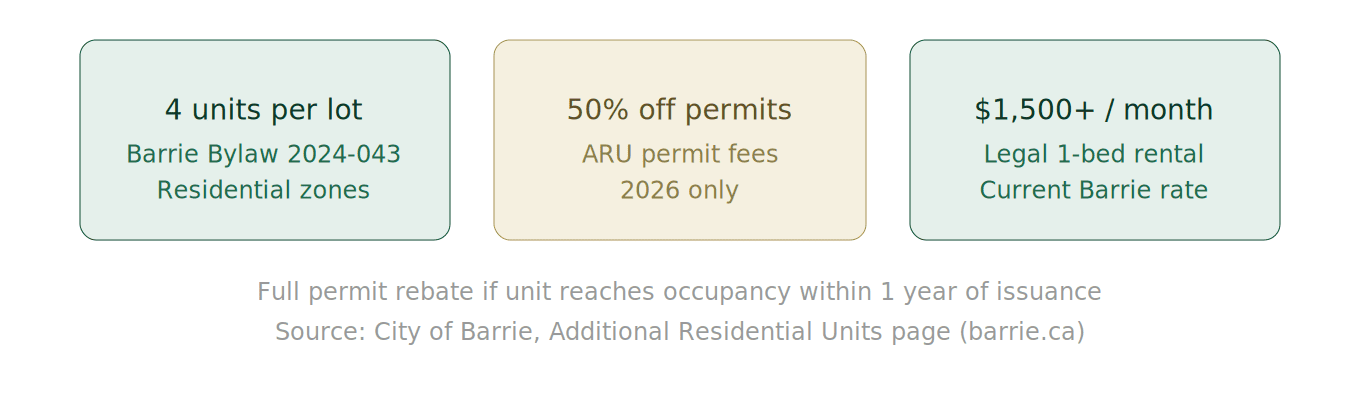
Barrie now allows up to four residential units per lot in residential zones. City Council passed By-law 2024-043 in April 2024, which means you can add up to three Additional Residential Units (ARUs) to your existing home. This applies to single detached homes, semi-detached homes, townhouses, and rowhouses. An ARU can be internal (a basement suite), attached, or detached (like a coach house or converted garage).
In 2026, the City of Barrie is offering 50% off building permit application fees for ARUs. If the unit achieves occupancy within one year of permit issuance, the city will rebate the full permit fee. The city has also released a set of standardized ARU designs to help homeowners get started faster.
Parking: You need one additional parking space for each ARU you add to the property. Tandem parking (one car behind another in the driveway) is permitted.
Registration: All secondary suites in Barrie must be registered with the city. Registration ensures that Fire and Emergency Services know the unit exists, which matters in an emergency response.
How to confirm your zoning: Use the City of Barrie’s interactive Planning and Development map online, or contact Service Barrie at 705-726-4242 or Service.Barrie@barrie.ca. Always confirm before you spend money on drawings or construction.
Permits You Will Need
Building a legal basement apartment in Barrie typically requires more than one permit. An Interior Alterations Permit covers the general finishing work: framing, insulation, drywall, flooring, and finishes. A Secondary Unit Permit covers the conversion to a legal dwelling unit and involves additional review for fire separation, egress, and life safety requirements. If you need to lower the basement floor for ceiling height, you will need a separate Underpinning Permit with engineered drawings. If you are adding an exterior entrance, you will need a Walkout Permit.
Permit approval timelines in Barrie currently range from two weeks to three months depending on scope and time of year. Summer is the busiest season for the building department. You will need permit drawings prepared by an architect, architectural technologist, or a qualified drafting service, typically $2,000 to $5,000 depending on complexity.
What This Costs in Barrie
A full legal basement apartment conversion typically runs $80 to $150 per square foot in Ontario, depending on the condition of the existing basement, the scope of the work, and the finishes. For a 750 square foot suite in Barrie with a separate entrance, kitchen, bathroom, bedroom, and living area, most projects land between $70,000 and $120,000 all in.
Here is a rough breakdown of where that money goes on a typical project.
Structural work (framing, insulation, 5/8-inch Type X drywall where required, standard drywall elsewhere) typically runs $12,000 to $20,000. This is the shell of the apartment, including all the walls that define the rooms and the fire-rated ceiling.
Mechanical is usually the largest category. Electrical (panel or sub-panel, circuits, lighting, ESA inspection) runs $8,000 to $15,000. Plumbing rough-in for the kitchen and bathroom, including any below-slab drain work, runs $8,000 to $15,000 depending on how far the new fixtures sit from the existing stack. HVAC (dedicated supply and return runs or a mini-split system) adds $4,000 to $8,000.
Finishes include the kitchen (cabinets, countertop, appliances, vented range hood) at $8,000 to $15,000, the bathroom (fixtures, tile, vanity, exhaust fan) at $6,000 to $12,000, flooring throughout at $4,000 to $8,000, and doors, trim, and paint at $3,000 to $6,000.
Additional costs that may or may not apply to your project: a separate exterior entrance ($8,000 to $20,000), egress window upgrades ($3,000 to $6,000 per window), interconnected smoke and CO alarm system ($500 to $1,500), and permit drawings and application fees ($3,500 to $8,000, reduced by 50% for ARU permits in 2026).
If you also need underpinning to gain ceiling height, add $50,000 to $80,000 on top of the apartment build cost.
If someone quotes you $30,000 for a complete legal basement apartment, either the scope does not include everything needed to pass inspection, or the work is not going to be done to code. Both scenarios cost more in the long run than doing it properly the first time.
What You Can Rent It For
Based on current Barrie rental listings (Kijiji, Trovit, and Apartments.com as of spring 2026), legal one-bedroom basement apartments typically rent for $1,500 to $2,000 per month depending on location, condition, and whether utilities are included. A well-finished two-bedroom suite with a separate entrance can command $1,800 to $2,300 or more.
On a $100,000 renovation investment, rental income of $1,800 per month ($21,600 per year before expenses) puts your payback period at roughly four to five years. After that, it is income, and you have permanently added significant value to the property.
The math works, but only if the suite is legal. An illegal unit that gets flagged by the city, or that causes an insurance claim to be denied, can cost you far more than the renovation itself.
After the Build: Inspections, Registration, and Insurance
Construction is only part of the process. There are three things that need to happen before you can rent the suite.
Final building inspection. The building inspector visits the unit to verify that all work matches the approved drawings, that fire separation is complete and properly sealed, that egress windows are installed correctly, and that all life safety systems are in place and interconnected. If anything fails, you address the deficiency and schedule a re-inspection.
ESA certificate. The Electrical Safety Authority must confirm that all electrical work passes their inspection. You will need this certificate for your final building sign-off and for your insurance.
Suite registration. All secondary suites in Barrie must be registered with the city through Service Barrie. Registration ensures Fire and Emergency Services have your unit on record, which matters if there is ever an emergency response at your address.
There is one more step that homeowners often skip: call your home insurance provider. You need to inform them that you have added a legal secondary suite. A legal, permitted suite is typically covered under a standard homeowner’s policy with an adjustment to your premium. An undisclosed suite, even a legal one, can create complications if you ever need to file a claim.
Frequently Asked Questions
What makes a basement apartment illegal in Ontario?
A basement apartment is illegal if it was built without a building permit or does not meet Ontario Building Code requirements for ceiling height, fire separation, egress windows, a separate entrance, or proper kitchen and bathroom facilities. Many older basement apartments in Barrie were finished without permits and do not meet current code.
Can I make an existing illegal basement apartment legal?
Yes, in most cases. A contractor can assess the current condition, identify what needs to change, and prepare drawings for a retroactive permit application. The cost depends on how much work is needed to bring the unit up to code, and it ranges from minor corrections to a full rebuild of what is already there.
Do I need a separate hydro meter for a basement apartment?
A separate meter is not required by the Ontario Building Code. However, it lets your tenant pay their own electricity, simplifies your landlord obligations, and makes the unit more attractive to tenants. Your electrician and local utility provider can walk you through the process and costs.
How long does it take to build a legal basement apartment in Barrie?
Most projects take three to six months from permit application to move-in. Construction itself typically runs 8 to 14 weeks depending on scope. The remaining time is permit processing, inspection scheduling, and lead time on materials and trades.
Can I build a basement apartment if my home is semi-detached or a townhouse?
Yes. Barrie’s current zoning allows Additional Residential Units in single detached homes, semi-detached homes, townhouses, and rowhouses. Confirm your specific property’s zoning with the City of Barrie before starting any work.
What happens if I rent out a basement that is not legal?
Your home insurance may deny any claim related to the suite. The city can issue orders requiring you to stop renting and remove the kitchen. You can face fines. In the worst case, if a fire or other emergency injures a tenant, you carry full personal liability for operating an unpermitted dwelling.
Thinking About a Legal Basement Apartment?
The hardest part is knowing where to start. We do a full assessment of your basement, including ceiling height, plumbing layout, and zoning confirmation, so you know exactly what your project involves and what it will cost before any work begins. Learn more about our basement renovation services.